
The conversion funnel is a tool used in digital marketing to understand the process that a user follows from their first contact with a brand to making a purchase.
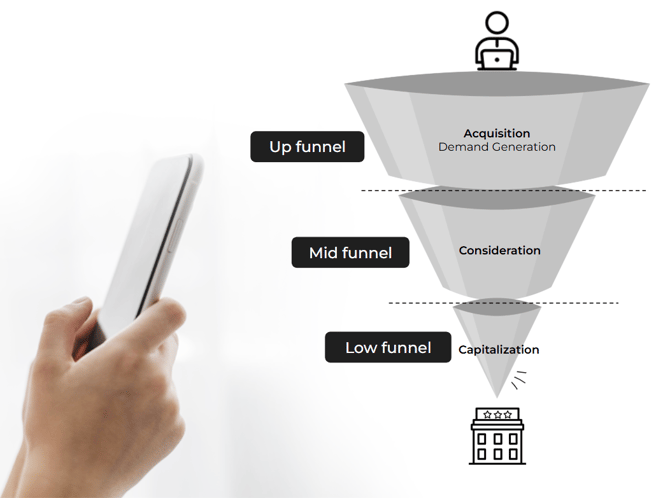
It is called a funnel, due to its similarity to this, where at the top are the users who are not yet familiar with the brand and at the bottom are those who have already made a purchase.
UP FUNNEL
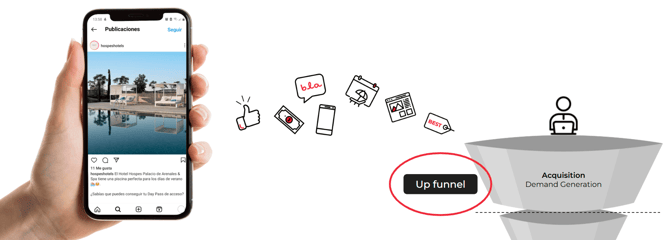
First, the up funnel (top of the funnel) is worked on to make our brand known to our target audience, which is a very important step for people to think of it the next time they are inclined to book a stay.
Companies can use different means to launch campaigns focused on this stage, such as television, social media, or YouTube videos, and can measure their success by analyzing, for example, the number of people who have seen the ads or their brand's reputation scores.
It is very important to note that actions in this first stage of the funnel do not have a direct and immediate effect on sales, but they will be the seeds for bookings in the medium to long term.
MID FUNNEL
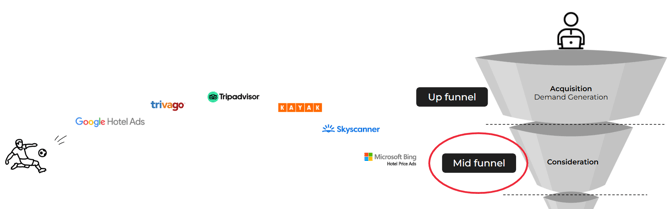
The mid-funnel is important because it helps us qualify the demand, meaning we target the right audience and increase the chances of generating more revenue in the lower part of the funnel; in other words, it's like a midfielder in football, whose job is to feed the lower funnel so it can score goals.
In the mid-funnel, we try to capture users who are already considering our hotel and use metrics such as clicks, impressions, bounce rate, and time on page to measure our success at this stage.
At this stage, metasearch engines can help us gain visibility, promoting our hotel and official website to potential customers, so that when it comes time to book (low funnel), they do so in the most cost-effective way for the hotel.
LOW FUNNEL
The ultimate goal of having a website is to grow your business and convert users into sales at the most convenient acquisition cost. That's what we do at the bottom of the funnel, focusing on converting users who are already considering our hotel into sales through our website.
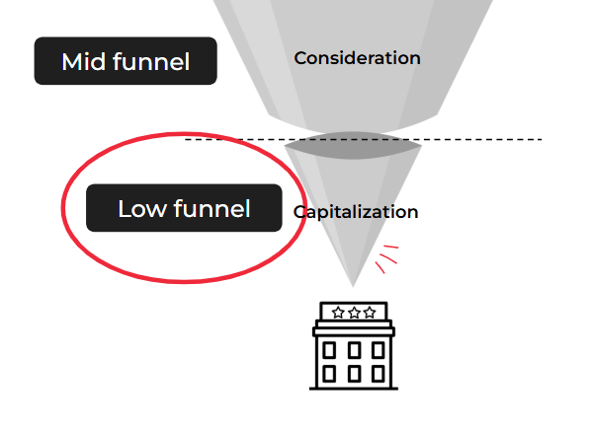
The low funnel is like a channel switching game where we aim to get users to book with us instead of through other distribution channels (OTAs).
At this stage, we invest money in activities that drive direct bookings, such as paid search and retargeting campaigns. To measure our success at this stage, we track parameters such as conversion rate and cost per acquisition (CPA), ideally focusing actions where people are already searching for our hotel, such as Google and Bing searches, and metasearch engines like Google Hotels Ads, TripAdvisor, and Trivago, among others.